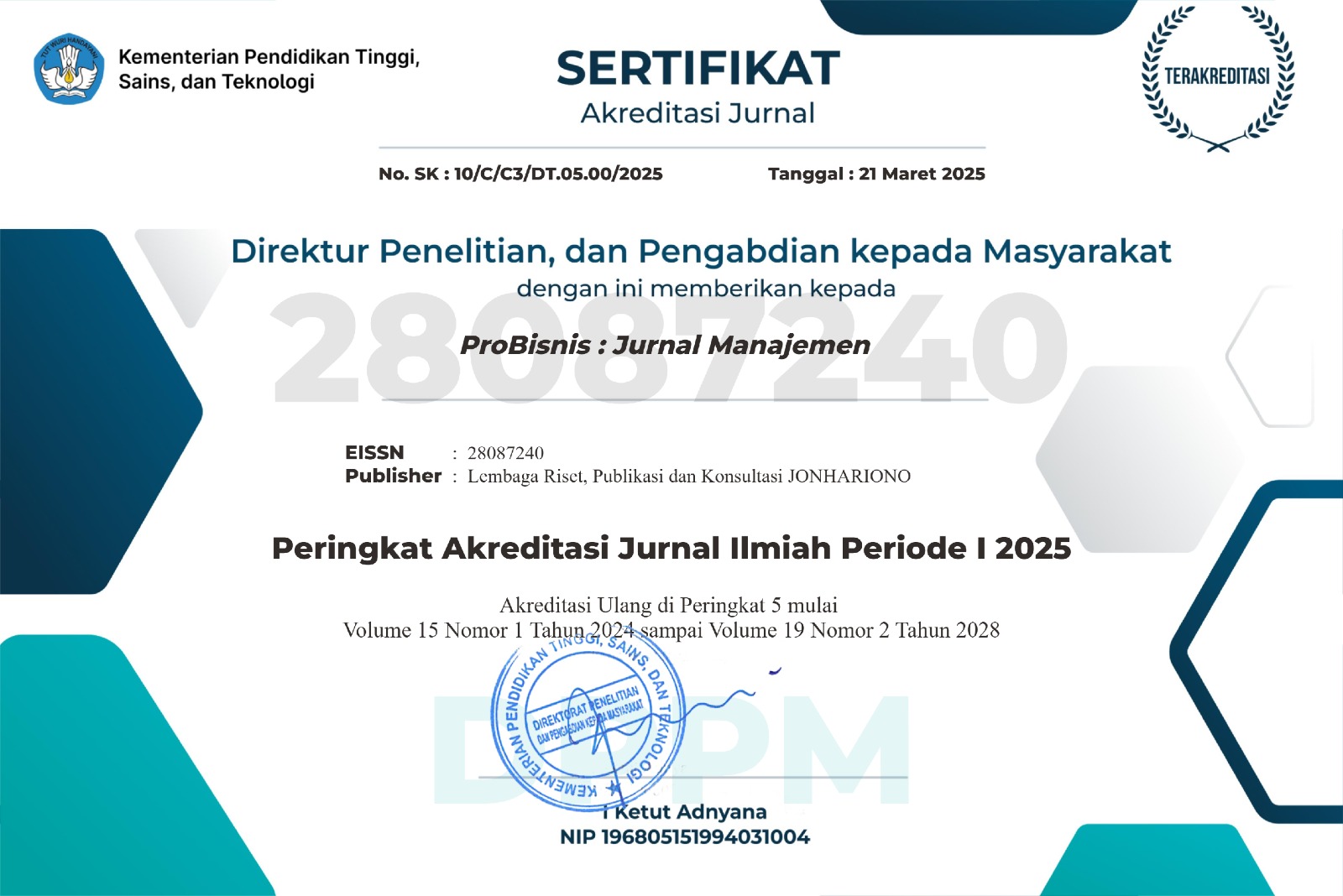
Pengaruh Promosi dan Kepercayaan terhadap Keputusan Pembelian melalui Persepsi Kemudahan Transaksi pada Nasabah Pegadaian UPC Soriutu
Keywords:
Promotion, Trust, Ease of Transaction, Purchasing Decision, PegadaianAbstract
This study aims to analyze the effect of promotion and trust on purchasing decisions through the perceived ease of transaction among customers of Pegadaian UPC Soriutu. The method used is a causal-associative quantitative approach with a saturated sampling technique of 81 active customer respondents, analyzed using multiple linear regression and path analysis. The results show that trust has a direct positive and significant effect on purchasing decisions, whereas promotion and perceived ease of transaction do not have a significant direct effect. Furthermore, perceived ease of transaction is unable to mediate the effect of either promotion or trust on purchasing decisions. The implications of these findings indicate that customers prioritize fulfilling financial needs and institutional trust over mere procedural ease, hence management is advised to focus more on strengthening service integrity and reliability. This research contributes by providing a critical note and enriching consumer behavior literature and the Technology Acceptance Model (TAM) in the traditional financial sector, proving that trust is a dominant predictor with a direct impact without needing mediation by perceived operational ease.
References
Afif, M., & Purwanto, P. (2019). Pengaruh Promosi, Kemudahan Akses, dan Kepercayaan Konsumen Terhadap Keputusan Pembelian. Jurnal Administrasi Bisnis (JAB). Tersedia pada: https://journal.fkpt.org/index.php/sinekad
Davis, F. D. (1989). Perceived usefulness, perceived ease of use, and user acceptance of information technology. MIS Quarterly, 13(3), 319–340.
Ghozali, I. (2021). Partial Least Squares: Konsep, Teknik dan Aplikasi Menggunakan SmartPLS 3.0 (3rd ed.). Badan Penerbit Universitas Diponegoro.
Hair, J. F., Hult, G. T. M., Ringle, C. M., & Sarstedt, M. (2017). A Primer on Partial Least Squares Structural Equation Modeling (PLS-SEM) (2nd ed.). Sage Publications.
Hawari, A. P., & Harahap, K. (2023). Pengaruh Promosi Dan Persepsi Kemudahan Dalam Penggunaan E-Wallet Shopeepay Terhadap Keputusan Pembelian Pada Masyarakat Kota Medan. Jurnal Ekonomi, Akuntansi dan Manajemen Indonesia (JEAMI), 2(1), 27–40. https://doi.org/10.58471/jeami.v2i01.90
Hidayat, A., & Kurniawan, R. (2022). Pengaruh Promosi dan Kepercayaan Terhadap Keputusan Nasabah dalam Menggunakan Layanan Jasa Keuangan. Jurnal Ilmu Ekonomi dan Bisnis, 5(2), 112-125.
Iliyin, A., & Widiartanto, W. (2020). Pengaruh Persepsi Kemudahan Penggunaan Dan Persepsi Keamanan Terhadap Keputusan Penggunaan OVO PT Visionet Data Internasional. Jurnal Ilmu Administrasi Bisnis, 9(1), 85–92. https://doi.org/10.14710/jiab.2020.26225
Juan, E., & Indrawati, L. (2023). Pengaruh Kepercayaan, Persepsi Kemudahan Penggunaan, dan Brand Image Terhadap Kepuasan Konsumen Melakukan Pembayaran Menggunakan QRIS. Konsumen & Konsumsi: Jurnal Manajemen, 2(1), 1–12. https://doi.org/10.32524/kkjm.v2i1.757
Kotler, P., & Armstrong, G. (2018). Principles of Marketing (17th ed.). Pearson Education Limited.
Kotler, P., & Keller, K. L. (2016). Marketing Management (15th ed.). Pearson Education, Inc.
Lestari, D., & Wahyuni, S. (2023). Pengaruh Persepsi Kemudahan terhadap Keputusan Penggunaan Jasa Keuangan pada Era Digital. Jurnal Manajemen dan Bisnis (JMB), 12(1), 45-58.
Mayer, R. C., Davis, J. H., & Schoorman, F. D. (1995). An integrative model of organizational trust. Academy of Management Review, 20(3), 709–734.
Morgan, R. M., & Hunt, S. D. (1994). The commitment-trust theory of relationship marketing. Journal of Marketing, 58(3), 20–38.
Prasetyo, F. E. (2018). Pengaruh Desain Website, Reputasi Vendor, Persepsi Kemudahan Transaksi dan Sikap Belanja Online Terhadap Keputusan Pembelian. Gadjah Mada International Journal of Business, 4(1), 15–28. https://doi.org/10.20961/ge.v4i1.19180
Putri, A. M., & Ramadhan, S. (2021). Pengaruh Kemudahan Transaksi dan Kepercayaan Terhadap Keputusan Pembelian Online. Jurnal Ekonomi dan Manajemen Sistem Informasi, 3(2), 211-222.
Rahmawati, Y., & Priyono, A. (2022). Pengaruh Promosi dan Kepercayaan terhadap Keputusan Pembelian melalui Persepsi Kemudahan sebagai Variabel Intervening. Jurnal Riset Manajemen, 8(3), 102-115.
Rodiah, S. R., & Melati, I. S. (2020). Pengaruh Kemudahan Penggunaan, Kemanfaatan, Risiko, dan Kepercayaan terhadap Minat Menggunakan E-wallet pada Generasi Milenial Kota Semarang. Journal of Economic Education and Entrepreneurship, 1(2), 66–80. https://doi.org/10.31331/jeee.v1i2.1293
Sari, M. D., & Nugroho, A. S. (2021). Pengaruh Kepercayaan dan Kemudahan terhadap Keputusan Penggunaan Layanan Keuangan Digital. Jurnal Manajemen Bisnis dan Kewirausahaan, 6(4), 134-145.
Schiffman, L. G., & Wisenblit, J. (2015). Consumer Behavior (11th ed.). Pearson Education.
Solihin, D. (2020). Pengaruh Kepercayaan Pelanggan dan Promosi Terhadap Keputusan Pembelian Konsumen Pada Online Shop Dengan Minat Beli Sebagai Variabel Intervening. Jurnal Mandiri: Ilmu Pengetahuan, Seni, dan Teknologi, 4(1), 38-51. https://doi.org/10.33753/mandiri.v4i1.104
Sugiyono. (2019). Metode Penelitian Kuantitatif, Kualitatif dan R&D. Alfabeta.
Tjiptono, F. (2017). Strategi Pemasaran (4th ed.). Andi Offset.
Utomo, J., & Nursyamsi, J. (2023). Analisis Pengaruh Persepsi Kemudahan Penggunaan, Persepsi Manfaat, dan Promosi Penjualan Terhadap Keputusan Pembelian. Jurnal Akuntansi dan Manajemen Bisnis, 2(1), 68-77. https://doi.org/10.56127/jaman.v2i1.411
Wahyuningtyas, Y. F., & Widiastuti, D. A. (2015). Analisis Pengaruh Persepsi Risiko, Kemudahan Dan Manfaat Terhadap Keputusan Pembelian Secara Online. Jurnal Kajian Bisnis, 23(2), 112–120. https://doi.org/10.32477/jkb.v23i2.208
Welsa, H., & Cahya, A. D. (2024). Pengaruh Kualitas Pelayanan, Promosi, dan Kemudahan Penggunaan Terhadap Keputusan Pembelian. JPEK (Jurnal Pendidikan Ekonomi dan Kewirausahaan), 8(2), 419-426. https://doi.org/10.29408/jpek.v8i2.24649
Yuli, A., & Rahmawati, E. (2022). Pengaruh Kepercayaan Terhadap Keputusan Pembelian Melalui Persepsi Kemudahan Transaksi. Jurnal Ilmu Manajemen, 10(2), 88-101.