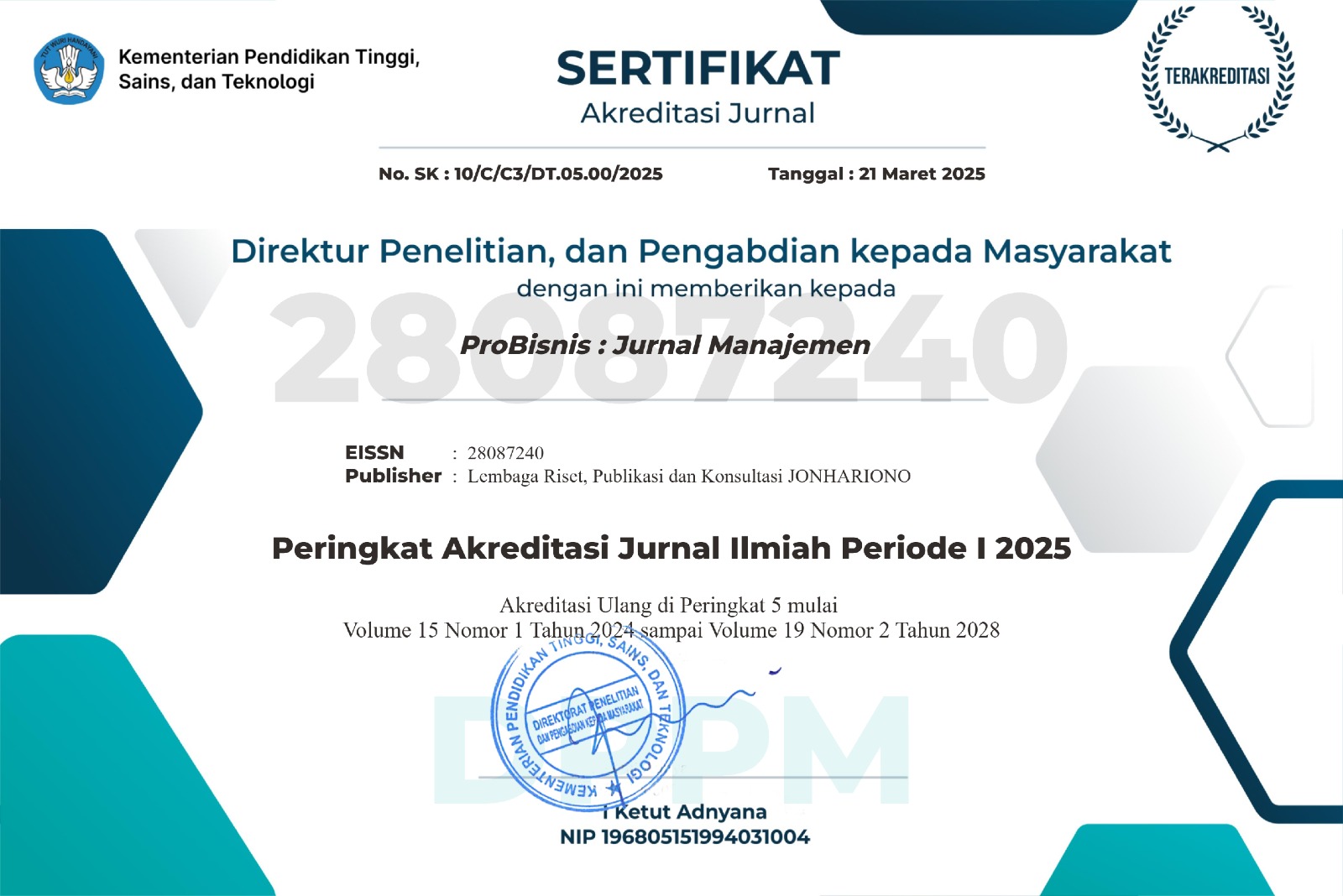
What Drives Human-Centered Leadership? Personal Excellence and Collaborative Excellence with AI Usage
Keywords:
Religiosity, Personal , Excellence , Collaborative , AI UsageAbstract
Human-centered leadership has become a term established due to increasing concern on organizations that need to balance technological improvement while maintain the importance of human values. This study investigates whether religiosity may serve as a source that is being mediated through personal excellence and collaborative excellence with AI usage as moderating variable. Data were collected from 400 employees across organizational levels in Indonesia, data were analyzed using PLS-SEM through SmartPLS 4.0. The result of this study shows that Religiosity positively strengthens both Personal Excellence (PE) and Collaborative Excellence (CE), which each contribute significantly to the establishment of Human-Centered Leadership (HCL). PE and CE also becomes mediators in this study, meaning that religiosity operates through how individuals develop and express excellence rather than acting on leadership directly. However, AI usage moderated none of these paths. The relationship between excellence and Human-Centered Leadership remains regardless of AI integration level. It provides important insight that AI influence operational efficiency rather than humanistic leadership qualities. These findings also shows that spiritual values may influence the personal and relational excellence that Human-Centered Leadership demands. AI functions as an operational tool, not a substitute of its human factor.
References
AACSB. (2024). Human-centered leadership and organizational performance: Evidence from global business schools. AACSB International.
Aduwo, E., Ibem, E., & Uwakonye, O. (2025). Collaborative excellence in organizations: Dimensions, process indicators, and outcome measures. International Journal of Organizational Management, 18(1), 45–63.
Aggarwal, R., Bhatt, R., & Bhatt, C. (2023). Religiosity, positive identity, and psychological well-being: Examining the mediating role of self-efficacy and self-esteem. Journal of Religion and Health, 62(1), 112–130.
Ahmada, F., Mukhtar, M., & Suharto, S. (2024). Non-financial rewards, employee engagement, and psychological well-being: An integrative perspective. Journal of Organizational Behavior, 45(2), 88–104.
Al-Qahtani, M., Al-Ghamdi, S., & Al-Harbi, K. (2021). Self-esteem and self-efficacy as predictors of individual empowerment. Journal of Applied Psychology, 106(3), 412–425.
Anders, S. (2021). Human-centered leadership: A cyclical development model for organizational change. Leadership and Organization Development Journal, 42(4), 501–518.
Arifin, Z., Supriyanto, A., & Tjahjono, H. (2024). Religiosity and human-centered leadership: Moral exemplar qualities and their influence on trust and organizational commitment. Journal of Business Ethics, 189(2), 345–361.
Astuti, R., Suharto, S., & Wahyudi, W. (2021). Teamwork, work environment, and compensation as drivers of employee motivation: A comparative regression analysis. Journal of Management and Business, 20(1), 45–58.
Bandura, A. (1986). Social foundations of thought and action: A social cognitive theory. Prentice-Hall.
Bandura, A. (1991). Social cognitive theory of self-regulation. Organizational Behavior and Human Decision Processes, 50(2), 248–287.
Bass, B. M. (1985). Leadership and performance beyond expectations. Free Press.
Burns, J. M. (1978). Leadership. Harper & Row.
Csaszar, F. A., Ostler, J., & Steinberger, J. (2021). Artificial intelligence and organizational decision-making. Strategic Management Journal, 42(9), 1698–1723.
Dasopang, M., Batubara, H., & Siregar, I. (2023). Religious values and peaceful conflict resolution: Building trust and social harmony in organizations. Journal of Islamic Studies, 34(1), 78–95.
Dave, K. (2017). Personal excellence: A framework for continuous self-development. International Journal of Human Resource Management, 28(6), 891–907.
Dubey, A. (2024). Self-awareness, self-management, and leader well-being: Implications for human-centered leadership. Leadership Quarterly, 35(1), 101–117.
Duerkar, M., Singh, P., & Mehta, A. (2021). Happiness, emotional stability, and humanistic leadership behavior: The connecting role of personal excellence. Journal of Positive Psychology, 16(4), 512–526.
Erken, H., Smeets, P., & van der Linden, D. (2021). Religiosity and empathy: The mediating role of emotional depth in prosocial behavior. Psychology of Religion and Spirituality, 13(4), 445–457.
Fauzi, M., Siagian, H., & Rajagukguk, W. (2025). AI usage in organizational work processes: Dimensions, measurement, and implications for performance. Computers in Human Behavior, 148, 107–121.
Filipovic, J., & Rihtar, S. (2023). Religious commitment and personal growth: Creativity, autonomy, and moral sensitivity. Archive for the Psychology of Religion, 45(2), 189–205.
Gabova, K., Kopkova, A., & Hricova, M. (2021). Religious practices, spiritual experiences, and self-esteem: A correlational study. Mental Health, Religion & Culture, 24(5), 512–527.
Gallup. (2025). State of the global workplace 2025 report. Gallup Press.
Gallup. (2025). Why does employee engagement research matter? Gallup Press.
Gupta, N., Singh, A., & Mehta, P. (2023). Team satisfaction and psychological well-being: The role of collaborative work environments. Journal of Occupational Health Psychology, 28(3), 201–215.
Hair, J. F., Risher, J. J., Sarstedt, M., & Ringle, C. M. (2021). A primer on partial least squares structural equation modeling (PLS-SEM) (3rd ed.). SAGE Publications.
Hameli, K., & Ordun, G. (2022). Emotional intelligence, self-efficacy, and organizational commitment: A mediation analysis. Journal of Organizational Psychology, 22(2), 89–104.
Hammett, R., Holton, E., & Burnett, M. (2010). Personal excellence: Intrapersonal, interpersonal, motivational, and leadership skill dimensions. Human Resource Development Review, 9(2), 159–183.
Hossain, M., Rahman, M., & Karim, R. (2025). AI-proficient leadership and ethical collaboration: The moderating role of AI management capability. Journal of Business Research, 172, 114–129.
Jabar, M., & Suharnomo, S. (2023). Religiosity-based leadership values, emotional intelligence, and employee performance: A mediation analysis. Journal of Islamic Marketing, 14(3), 678–694.
Jain, P., Kumar, R., & Sharma, V. (2022). AI adoption and collaborative work environments: The role of effort expectancy, performance expectancy, and social influence. Technological Forecasting and Social Change, 178, 121–136.
Jarrahi, M. H., Lutz, C., & Abedin, B. (2022). Artificial intelligence and knowledge work: A partnership perspective. International Journal of Information Management, 62, 102–117.
Kennedy, F., Carroll, B., & Francoeur, J. (2020). Putting human back into human resources: A leader's guide to human-centered leadership. Jossey-Bass.
Khalida, R., Santoso, B., & Wulandari, F. (2023). Workplace culture in Indonesia: Religiosity, social harmony, and interpersonal relationships as organizational values. Asian Journal of Business and Management, 11(2), 34–48.
Kim, J. (2025). Religious organizational culture, compensation structures, and moral accountability in performance management. Journal of Business Ethics, 192(1), 211–227.
Leclerc, L., Kennedy, K., & Campis, S. (2020). Human-centered leadership in health care: An idea that emerged from the chaos. Nursing Administration Quarterly, 44(2), 117–128.
Lin, C. (2022). Distributed leadership, teacher autonomy, and professional collaboration as mediators of teacher innovativeness. Educational Management Administration & Leadership, 50(4), 612–629.
Madanchian, M., Hussein, N., Noordin, F., & Taherdoost, H. (2024). Leadership in the age of AI: Navigating the balance between data-driven decisions and human values. Journal of Leadership Studies, 18(1), 45–59.
Maliakkal, N., & Palmon, O. (2022). Leadership support, creativity, and collaboration: The role of idea recognition and restraint of negative judgment. Journal of Creative Behavior, 56(2), 278–294.
Manzoor, F., Wei, L., & Asif, M. (2021). Intrinsic rewards, workplace motivation, and employee performance: A mediation analysis. Frontiers in Psychology, 12, 563–579.
Marta, I., Sinarwati, N., & Diatmika, I. (2020). Employee empowerment, work motivation, job satisfaction, and organizational commitment: A mediation study. International Journal of Social Science and Business, 4(3), 321–334.
Meyer, A., Tofel-Grehl, C., & Richardson, T. (2020). Principal leadership, collective efficacy, and teacher collaboration: An indirect effects model. Journal of Educational Administration, 58(4), 411–426.
Microsoft. (2025). 2025 work trend index: AI at work in Indonesia. Microsoft Corporation.
Mousa, M., & Chaouali, W. (2021). Religiosity, organizational culture, and workplace behavior: A conceptual framework. Journal of Management, Spirituality & Religion, 18(4), 289–307.
Mukhtar, U., Javed, U., & Bilal, M. (2022). Transformational leadership, teamwork, and motivation: Building trust and well-being in organizational teams. Journal of Organizational Effectiveness, 9(2), 178–194.
Munayer, S. (2024). Religious identity, moral leadership, and the cultivation of trust in organizations. Journal of Business Ethics, 190(3), 567–582.
Muris, P., & Otgaar, H. (2023). Self-esteem, self-compassion, and well-being: A meta-analytic review of their relationships and moderators. Clinical Psychology Review, 99, 102–118.
Otaye-Ebede, L., Shaffakat, S., & Foster, S. (2019). A multilevel model examining the relationships between workplace spirituality, ethical climate, and outcomes. Journal of Business Ethics, 166(3), 611–626.
Palm, R., Lewis, G., & Feng, B. (2021). Religious practices, self-control, and moral resilience: The disciplining effect of prayer and worship. Psychology of Religion and Spirituality, 13(2), 201–214.
Peifer, C., Zipp, G., & Schächter, J. (2022). Artificial intelligence and leadership: Implications for decision-making, empathy, and human values. Leadership & Organization Development Journal, 43(5), 723–738.
Pelser, T. (2023). Collaborative excellence as organizational capability: Value creation, human development, and innovation across industries. South African Journal of Business Management, 54(1), 1–14.
Raisch, S., & Krakowski, S. (2021). Artificial intelligence and management: The automation-augmentation paradox. Academy of Management Review, 46(1), 192–210.
Reid, R. (2021). Collaborative excellence and organizational resilience: How effective cooperation enables faster adaptation under uncertainty. Journal of Business Research, 134, 612–624.
Riedl, C., & Cremer, D. (2025). AI and collective intelligence: Optimizing memory, attention, and reasoning in organizational teams. Organization Science, 36(1), 112–130.
Rifki, M., Anshori, M., & Wahyuni, S. (2024). Religiosity, collective discipline, and collaborative culture: Implications for organizational performance. Journal of Islamic Management Studies, 7(1), 45–61.
Safuan, S. (2025). Human-centered leadership: Dimensions, theoretical roots, and systematic characteristics. Journal of Leadership and Organizational Studies, 32(1), 12–28.
Samara, G., Jamali, D., & Parada, M. (2024). AI-driven decision-making in organizations: Accuracy, efficiency, personalization, and goal orientation. Journal of Business Research, 168, 114–128.
Schunk, D. H., & DiBenedetto, M. K. (2020). Motivation and social cognitive theory. Contemporary Educational Psychology, 60, 101–117.
Shah, N., Zehri, A., & Saeed, I. (2025). Problem-solving conflict management style and employee well-being: The mediating role of psychological safety. International Journal of Conflict Management, 36(2), 178–194.
Syamsuri, A., & Zakaria, Z. (2025). Leadership without human values: Communication patterns, pressure-based motivation, and their impact on employee productivity in Indonesian organizations. Asian Journal of Management Sciences & Education, 14(1), 67–81.
Tran, T., Nguyen, N., & Le, H. (2022). Self-esteem, mindfulness, self-compassion, and well-being: A mediation study among workers. Current Psychology, 41(8), 5560–5571.
Vivek, S., & Krupskyi, O. (2024). Emotional intelligence, artificial intelligence, and leadership effectiveness: Implications for talent management and organizational outcomes. Journal of Leadership Studies, 18(2), 89–104.
Widiyono, W. (2021). Religiosity, teamwork, and total quality management: The role of personal responsibility and institutional commitment. Journal of Islamic Management, 5(2), 112–128.
Wijayanti, R., & Nurhayati, M. (2021). Religiosity as cognitive, affective, and behavioral construct: Implications for organizational behavior. Journal of Religion and Business Ethics, 4(1), 1–18.
Wiroonrath, P., Chanin, O., & Kraiwanit, T. (2024). Leader support, organizational culture, intellectual property,
1.jpg)