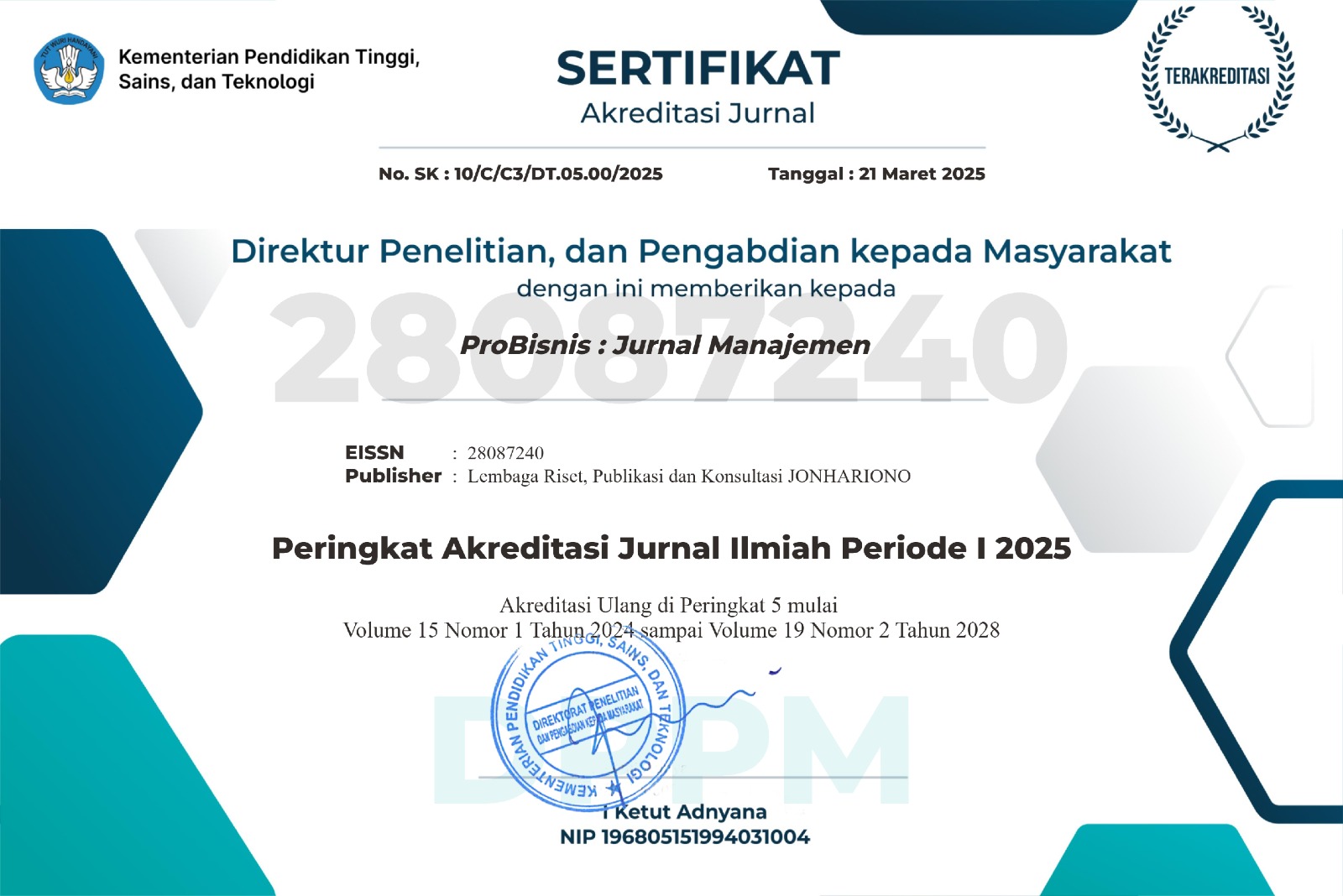
The Effect of FHRM and Open Innovation on Organizational Resilience mediated by Intellectual Capital on Employees of PT Telkom Indonesia in Jakarta
Keywords:
Flexible human resource management, Open innovation, Organizational Resilience, Intellectual capitalAbstract
This study aims to analyze the influence of Flexible Human Resource Management (FHRM) and open innovation on organizational resilience, mediated by intellectual capital. The research was conducted on employees of PT. Telkom Indonesia in Jakarta, using a quantitative method with a survey approach. Data were collected through questionnaires distributed to 181 respondents selected using a purposive sampling technique. Data analysis was carried out using Structural Equation Modeling (SEM) to examine both direct and mediating relationships among variables. The results reveal that FHRM and open innovation significantly impact organizational resilience, both directly and through the mediating role of intellectual capital. Intellectual capital was found to be a critical factor in strengthening the influence of FHRM and open innovation on organizational resilience. These findings provide practical implications for companies in designing human resource management and innovation strategies to enhance adaptability and organizational sustainability in the face of dynamic business environment challenges.
References
Aljuboori, Z. M., Singh, H., Haddad, H., Al-Ramahi, N. M., & Ali, M. A. (2022). Intellectual Capital and Firm Performance Correlation: The Mediation Role of Innovation Capability in Malaysian Manufacturing SMEs Perspective. Sustainability (Switzerland), 14(1). https://doi.org/10.3390/su14010154
Al-Omoush, K. S., Palacios-Marqués, D., & Ulrich, K. (2022). The impact of intellectual capital on supply chain agility and collaborative knowledge creation in responding to unprecedented pandemic crises. Technological Forecasting and Social Change, 178(February). https://doi.org/10.1016/j.techfore.2022.121603
Asiaei, K., & Jusoh, R. (2015). A multidimensional view of intellectual capital: The impact on organizational performance. Management Decision, 53(3), 668–697. https://doi.org/10.1108/MD-05-2014-0300
Bhamra, R., Dani, S., & Burnard, K. (2011). Resilience: The concept, a literature review and future directions. In International Journal of Production Research (Vol. 49, Issue 18, pp. 5375–5393). https://doi.org/10.1080/00207543.2011.563826
Bogers, M., Chesbrough, H., & Moedas, C. (2018). Open innovation: Research, practices, and policies. California Management Review, 60(2), 5–16. https://doi.org/10.1177/0008125617745086
Bogers, M., Zobel, A. K., Afuah, A., Almirall, E., Brunswicker, S., Dahlander, L., Frederiksen, L., Gawer, A., Gruber, M., Haefliger, S., Hagedoorn, J., Hilgers, D., Laursen, K., Magnusson, M. G., Majchrzak, A., McCarthy, I. P., Moeslein, K. M., Nambisan, S., Piller, F. T., … Ter Wal, A. L. J. (2017). The open innovation research landscape: established perspectives and emerging themes across different levels of analysis. Industry and Innovation, 24(1), 8–40. https://doi.org/10.1080/13662716.2016.1240068
Chesbrough, H., & Bogers, M. (2013). Explicating Open Innovation: Clarifying an Emerging Paradigm for Understanding Innovation. http://ssrn.com/abstract=2427233Electroniccopyavailableat:https://ssrn.com/abstract=2427233Electroniccopyavailableat:http://ssrn.com/abstract=2427233
Daou, A., Joseph, J., Yousif, D. S., Fathallah, R., & Reyes, G. (2019). Intellectual capital and resilience in torn societies. Journal of Intellectual Capital, 20(4), 598–618. https://doi.org/10.1108/JIC-01-2019-0008
Duchek, S. (2020). Organizational resilience: a capability-based conceptualization. Business Research, 13(1), 215–246. https://doi.org/10.1007/s40685-019-0085-7
Emilisa, N., Yudhaputri, E. A., Trisakti, U., & Dizar, S. (2024.-a). Connections Between Work-Life Balance and Job Insecurity among Firefighters in Jakarta Indonesia.
Emilisa, N., Yudhaputri, E. A., Trisakti, U., & Dizar, S. (2024b). Connections Between Work-Life Balance and Job Insecurity among Firefighters in Jakarta Indonesia.
Farah, A., Calista, I., & Hartono, A. (2024). PT TELKOM INDONESIA’S DIGITAL TRANSFORMATION STRATEGY FACING THE DIGITAL ERA BY UTILIZING CORPORATE COMMUNICATIONS.
Farzaneh, M., Wilden, R., Afshari, L., & Mehralian, G. (2022). Dynamic capabilities and innovation ambidexterity: The roles of intellectual capital and innovation orientation. Journal of Business Research, 148(April 2021), 47–59. https://doi.org/10.1016/j.jbusres.2022.04.030
Gebremichael, H. S. (2018). The impact of open innovation practice on innovative performance through intellectual capital: Empirical study on SMEs. African Journal of Business Management, 12(20), 609–619. https://doi.org/10.5897/ajbm2018.8651
Hair, J. F., Tomas, G., Hult, M., Ringle, C. M., & Sarstedt, M. (2022). A Primer on Partial Least Squares Structural Equation Modeling (PLS-SEM). https://www.researchgate.net/publication/354331182
He, D. S., Liu, T. W., & Lin, Y. Y. (2024). Efficiency evaluation of intellectual capital for value creation: a case study of the semiconductor industry in Taiwan. Journal of Intellectual Capital, 25(4), 744–774. https://doi.org/10.1108/JIC-11-2023-0259
Kusuma, E. A., Pribadiyono, & Riharjo, I. B. (2021). Transformasi Digital Industri Telekomunikasi di Era Disrupsi.
Lee, A. V., Vargo, J., & Seville, E. (2013a). Developing a Tool to Measure and Compare Organizations’ Resilience. Natural Hazards Review, 14(1), 29–41. https://doi.org/10.1061/(asce)nh.1527-6996.0000075
Lee, A. V., Vargo, J., & Seville, E. (2013b). Developing a Tool to Measure and Compare Organizations’ Resilience. Natural Hazards Review, 14(1), 29–41. https://doi.org/10.1061/(asce)nh.1527-6996.0000075
Liu, X., Zhang, X., Jia, M., Fan, L., Lu, W., & Zhai, X. (2018). 5G-based green broadband communication system design with simultaneous wireless information and power transfer. Physical Communication, 28, 130–137. https://doi.org/10.1016/j.phycom.2018.03.015
Miller, D. (2003). An asymmetry-based view of advantage: Towards an attainable sustainability. Strategic Management Journal, 24(10 SPEC ISS.), 961–976. https://doi.org/10.1002/smj.316
Naqshbandi, M. M. (2016). Managerial ties and open innovation: examining the role of absorptive capacity. Management Decision, 54(9), 2256–2276. https://doi.org/10.1108/MD-03-2016-0161
Randhawa, K., Wilden, R., & Hohberger, J. (2016). A Bibliometric Review of Open Innovation: Setting a Research Agenda. Journal of Product Innovation Management, 33(6), 750–772. https://doi.org/10.1111/jpim.12312
Roumpi, D. (2023). Rethinking the strategic management of human resources: lessons learned from Covid-19 and the way forward in building resilience. International Journal of Organizational Analysis, 31(1), 215–231. https://doi.org/10.1108/IJOA-09-2021-2974
Schilke, O., Hu, S., & Helfat, C. E. (2018). Quo vadis, dynamic capabilities? A content-analytic review of the current state of knowledge and recommendations for future research. Academy of Management Annals, 12(1), 390–439. https://doi.org/10.5465/annals.2016.0014
Sekaran Uma, & Bougie Roger. (2016). Research Methods for Business: A Skill-Building Approach. https://doi.org/http://lccn.loc.gov/2015051045
Shipton, H., Sanders, K., Atkinson, C., & Frenkel, S. (2016). Sense-giving in health care: the relationship between the HR roles of line managers and employee commitment. Human Resource Management Journal, 26(1), 29–45. https://doi.org/10.1111/1748-8583.12087
Siddiq, M. U., & Sultan, S. A. (2023). Role of Flexibility-oriented HRM System in Promoting Human Resource Flexibility for Firm Innovation. In Journal of Personnel Management (Vol. 1, Issue 1).
Teece, D., Peteraf, M., & Leih, S. (2016). Dynamic Capabilities and Organizational Agility: RISK, UNCERTAINTY, AND STRATEGY IN THE INNOVATION ECONOMY.
Timothy, vogus, & Kathleen, M. S. (2007). sitasi vogus2007.
Vogus, T. J., & Sutcliffe, K. M. (2007). Organizational resilience: Towards a theory and research agenda. Conference Proceedings - IEEE International Conference on Systems, Man and Cybernetics, 3418–3422. https://doi.org/10.1109/ICSMC.2007.4414160
Williams, T. A., Gruber, D. A., Sutcliffe, K. M., Shepherd, D. A., & Zhao, E. Y. (2017). Organizational response to adversity: Fusing crisis management and resilience research streams. Academy of Management Annals, 11(2), 733–769. https://doi.org/10.5465/annals.2015.0134
Zighan, S., & Ruel, S. (2023). SMEs’ resilience from continuous improvement lenses. Journal of Entrepreneurship in Emerging Economies, 15(2), 233–253. https://doi.org/10.1108/JEEE-06-2021-0235
1.jpg)