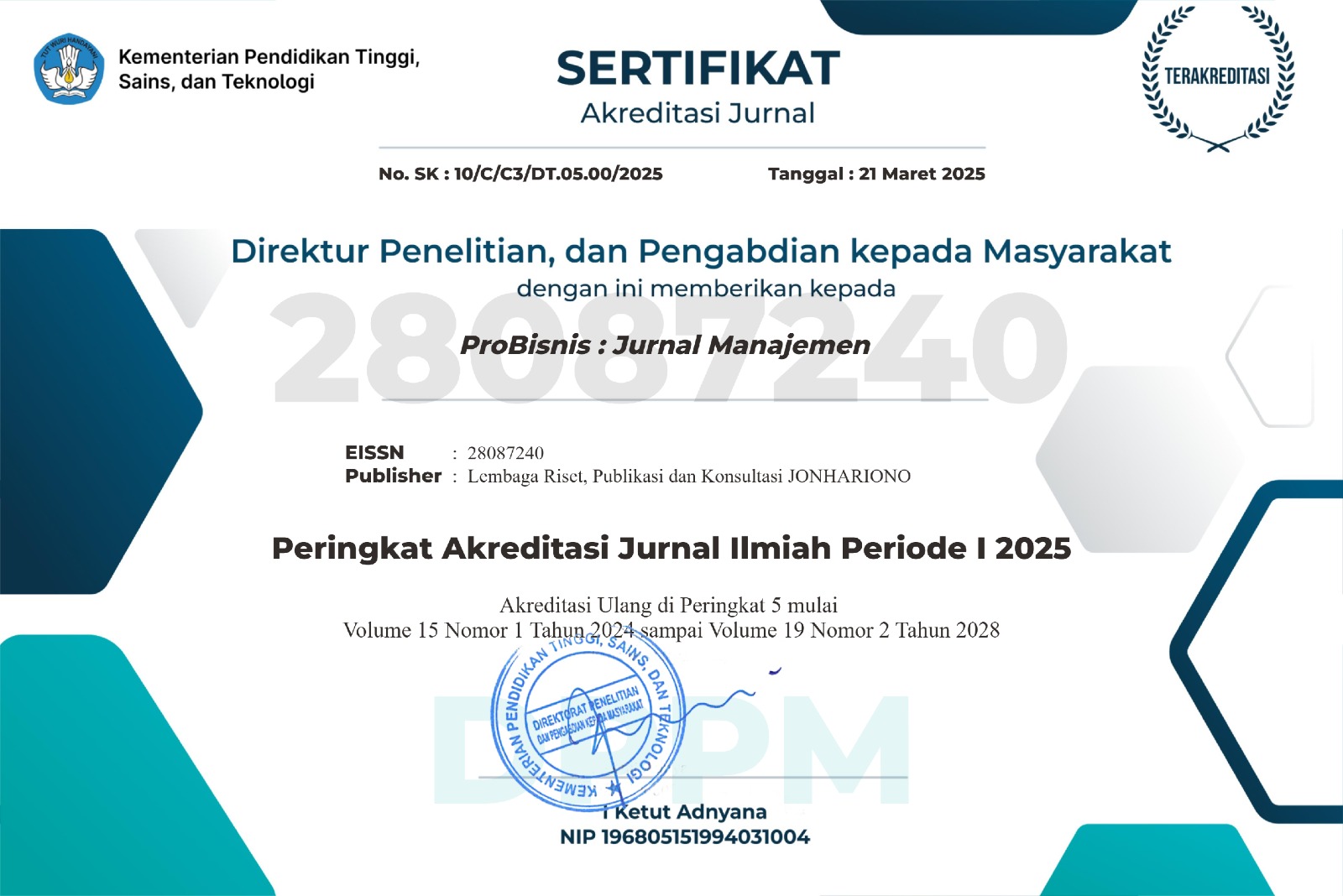
Employee Voice Behavior in Regional Banking: The Effects of Job Autonomy, Person–Organization Fit, and Work Engagement
Keywords:
Person Organitation Fit, Work Engagement, Voice Behavior, Job AutonomyAbstract
In the era of industrial and digital transformation, organizations are required to remain adaptive and innovative to maintain competitiveness. The banking sector, including regional institutions such as Bank Nagari, faces increasing customer demands and service-related complaints, necessitating stronger employee involvement in continuous improvement efforts. This study examines the influence of job autonomy, person–organization fit, and work engagement on employee voice behavior at the Main Branch Office (KCU) of Bank Nagari, located on Jalan Pemuda No. 21, Padang. The research was conducted in 2025 using a quantitative, cross-sectional design. Data were collected from 108 employees through structured questionnaires and analyzed using multiple linear regression. The results indicate that person–organization fit has a significant positive effect on employee voice behavior (Coef = 0.21; p = 0.000), whereas job autonomy (Coef = 0.06; p = 0.455) and work engagement (Coef = –0.007; p = 0.879) show no significant influence. These findings suggest that value alignment between individuals and the organization is more essential in fostering employee voice than structural or motivational aspects. Practically, the study highlights the importance of creating an open organizational climate, strengthening recruitment based on value congruence, internalizing organizational culture, and promoting leadership that encourages employee expression to enhance innovation and organizational development within the banking sector.
References
Alfes, K., Shantz, A., & Alahakone, R. (2016). Testing additive versus interactive effects of person-organization fit and organizational trust on engagement and performance. Personnel Review, 45(6), 1323–1339. https://doi.org/10.1108/PR-02-2015-0029
Bakker, A. B. (2006). schaufeli2006 EE definition.pdf. 701–716.
Bhave, S. vishnu. (2023). EMPLOYEE ENGAGEMENT. 02.
Caso, L., D’Ambrosio, R., & Transirico, M. (2015). W 2, p -solvability of the Dirichlet problem for elliptic equations with singular data. Abstract and Applied Analysis, 2015(October 2003), 331–362. https://doi.org/10.1155/2015/635035
Chan, S. C. H. (2014). Paternalistic leadership and employee voice: Does information sharing matter? Human Relations, 67(6), 667–693. https://doi.org/10.1177/0018726713503022
Chen, A. S. Y., & Hou, Y. H. (2016). The effects of ethical leadership, voice behavior and climates for innovation on creativity: A moderated mediation examination. Leadership Quarterly, 27(1), 1–13. https://doi.org/10.1016/j.leaqua.2015.10.007
Chen, L., Li, M., Wu, Y. J., & Chen, C. (2020). The voicer’s reactions to voice: an examination of employee voice on perceived organizational status and subsequent innovative behavior in the workplace. Personnel Review, 50(4), 1073–1092. https://doi.org/10.1108/PR-07-2019-0399
Chen, S. J., Wang, M. J., & Lee, S. H. (2018). Transformational leadership and voice behaviors: The mediating effect of employee perceived meaningful work. Personnel Review, 47(3), 694–708. https://doi.org/10.1108/PR-01-2017-0016
Cheng, jan W. (2009). Industrial Management & Data Systems Article information :
Chiang, C. F., & Chen, J. an. (2021). How Empowering Leadership and a Cooperative Climate Influence Employees’ Voice Behavior and Knowledge Sharing in the Hotel Industry. Journal of Quality Assurance in Hospitality and Tourism, 22(4), 476–495. https://doi.org/10.1080/1528008X.2020.1802391
Dharma, S. (2022). Analisis Statistik Terapan Dalam Penelitian Sosial Dengan Stata (1st ed.). In Media. in media.
Hackman, J. R., & Oldham, G. R. (1976). Motivation through the design of work: test of a theory, Organizational Behaviour and Human Performance. Organizational Behavior and Human Performance, 16(170), 250–279. http://web.mit.edu/curhan/www/docs/Articles/15341_Readings/Group_Performance/Hackman_et_al_1976_Motivation_thru_the_design_of_work.pdf
Kalemci, R. A., Kalemci-Tuzun, I., & Ozkan-Canbolat, E. (2019). Psychological Antecedents of Promotive and Prohibitive Voice: a Two-Wave Examination. Academy of Management Journal, 28(2), 126–141.
Kao, K. Y., Hsu, H. H., Thomas, C. L., Cheng, Y. C., Lin, M. T., & Li, H. F. (2022). Motivating employees to speak up: Linking job autonomy, P-O fit, and employee voice behaviors through work engagement. Current Psychology, 41(11), 7762–7776. https://doi.org/10.1007/s12144-020-01222-0
Knoll, M., & Redman, T. (2016). Does the Presence of Voice Imply the Absence of Silence? The Necessity to Consider Employees’ Affective Attachment and Job Engagement. Human Resource Management, 55(5), 829–844. https://doi.org/10.1002/hrm.21744
Kristof, A. L. (1996). Person-organization fit: An integrative review of its conceptualizations, measurement, and implications. Personnel Psychology, 49(1), 1–49. https://doi.org/10.1111/j.1744-6570.1996.tb01790.x
Lauver, K. J., & Kristof-Brown, A. (2001). Distinguishing between employees’ perceptions of person-job and person-organization fit. Journal of Vocational Behavior, 59(3), 454–470. https://doi.org/10.1006/jvbe.2001.1807
Lena Ellitan. (2002). Praktik-Praktik Pengelolaan Sumber Daya Manusia Dan Keunggulan Kompetitif Berkelanjutan. Jurnal Manajemen Dan Kewirausahaan, 4(2), pp.65-76. http://puslit2.petra.ac.id/ejournal/index.php/man/article/view/15623
LePine, J. A., & Van Dyne, L. (1998). Predicting voice behavior in work groups. Journal of Applied Psychology, 83(6), 853–868. https://doi.org/10.1037/0021-9010.83.6.853
Liang, J., Farh, C. I. C., & Farh, J. L. (2012). Psychological antecedents of promotive and prohibitive Voice: A two-wave examination. Academy of Management Journal, 55(1), 71–92. https://doi.org/10.5465/amj.2010.0176
Morrison, E. W. (2011). Employee voice behavior: Integration and directions for future research. Academy of Management Annals, 5(1), 373–412. https://doi.org/10.1080/19416520.2011.574506
Morrison, E. W., Wheeler-Smith, S. L., & Kamdar, D. (2011). Speaking Up in Groups: A Cross-Level Study of Group Voice Climate and Voice. Journal of Applied Psychology, 96(1), 183–191. https://doi.org/10.1037/a0020744
Osborne, S., & Hammoud, M. S. (2017). Effective Employee Engagement in the Workplace. International Journal of Applied Management and Technology, 16(1). https://doi.org/10.5590/ijamt.2017.16.1.04
Reisa, A., & Sudibjo, N. (2020). Employee Voice Behavior : Pengaruh Self-efficacy , Kepribadian Proaktif dan Work Engagement dalam Organisasi Pendidikan. 141–151.
Salsabila, D. R., Eliyana, A., & Sridadi, A. R. (2023). Voice Behavior: A Systematic Literature Review – A Model of Antecedents and Outcomes. Jurnal Ecodemica : Jurnal Ekonomi Manajemen Dan Bisnis, 7(1), 148–159. https://doi.org/10.31294/eco.v7i1.14617
Setiawan Maulana, M., Sofiah, D., Prasetyo, Y., & Psikologi, F. (2023). Work engagement pada karyawan: Bagaimana peranan perceived organizational support? INNER: Journal of Psychological Research, 3(1), 20–27.
Susanto, H. (2019). Otonomi Kerja, Pola Karir Dan Locus of Control Pegawai Tidak Tetap Pemerintahan (PTTP) (Studi Kasus DPMPTSP Kota Surabaya). Prosiding FRIMA (Festival Riset Ilmiah Manajemen Dan Akuntansi), 0917242530(2), 413–418. https://doi.org/10.55916/frima.v0i2.62
Sylvana, A., Awaluddin, M., Dueramae, H., & Sanusi, N. U. Y. (2024). The Role of Person-Organization Fit , Person-Job Fit , and Job Satisfaction in Enhacing the Performance of Universitas Terbuka ’ s Lectures. Al-Mashrafiyah: Jurnal Ekonomi, Keuangan Dan Perbankan Syariah, 8(1).
Um-E-Rubbab, & Mehdi Raza Naqvi, S. M. (2020). Employee voice behavior as a critical factor for organizational sustainability in the telecommunications industry. PLoS ONE, 15(9 September), 1–17. https://doi.org/10.1371/journal.pone.0238451
Van Dyne, L., & LePine, J. A. (1998). Helping and voice extra-role behaviors: Evidence of construct and predictive validity. Academy of Management Journal, 41(1), 108–119. https://doi.org/10.2307/256902
Yaqoub, E., Ismail, M., Abdullah, H., & Alnoor, A. (2020). Effect of Perceived Support on Employees Voice Behavior Through the Work Engagement: A Moderator Role of Locus of Control. International Journal of Process Management and Benchmarking, 1(1), 1. https://doi.org/10.1504/ijpmb.2020.10033080
Zhu, H., Khan, M. K., Nazeer, S., Li, L., Fu, Q., Badulescu, D., & Badulescu, A. (2022). Employee Voice: A Mechanism to Harness Employees’ Potential for Sustainable Success. International Journal of Environmental Research and Public Health, 19(2), 1–20. https://doi.org/10.3390/ijerph19020921
1.jpg)